

#coffee wood chew
#dog chews
#hard chew toys
#pet deals
A coffee wood chew can be a poor deal if you treat the low price as proof that it is safe for every dog. The issue is not that every wood-style chew is automatically dangerous, it is that hard chews can be too tough for some teeth, too small after a few sessions, or poorly matched to a strong chewer. Before you buy one from a middle-aisle pet event, Amazon listing or pet-store bin, check hardness, size, supervision rules and the return terms.
Why This Deal Is Showing Up Now
Summer pet promotions are leaning hard into outdoor toys, cooling products and cheap dog chews. Aldi UK’s June 2026 Pet Shop range, for example, lists a Coffee Wood Chew Bone alongside floating toys, cooling beds and other seasonal dog products, with the range landing in stores from June 21 while stocks last.
That makes the timing useful for dog owners, but it also creates a classic checkout problem. A chew that looks like a simple add-on can become expensive if it is too hard for your dog’s teeth, too small for safe chewing, or promoted with vague claims that do not match how your dog actually chews.
The Detail To Check Before You Add It To The Basket
The first check is hardness. Cornell University College of Veterinary Medicine quotes veterinary guidance warning that many hard or abrasive objects can break teeth, and that suitable chew toys should generally have some bend or be soft enough to indent with a fingernail. VCA Animal Hospitals gives similar shopping guidance and warns that very hard items, including bones, hooves, hard rawhides and large ice cubes, can chip or fracture teeth.
Coffee wood chews are usually marketed as natural, long-lasting and less splinter-prone than ordinary sticks. Those claims still do not answer the most important question: can your own dog chew this item without turning it into a tooth, choking or swallowing problem?
If the chew feels rock-hard, cannot be dented at all, or is intended for aggressive chewing, be cautious with puppies, seniors, dogs with known dental disease, small breeds, flat-faced breeds and dogs that try to crunch instead of gnaw. Ask your veterinarian before buying if your dog has had cracked teeth, extractions, oral pain or a diet restriction.
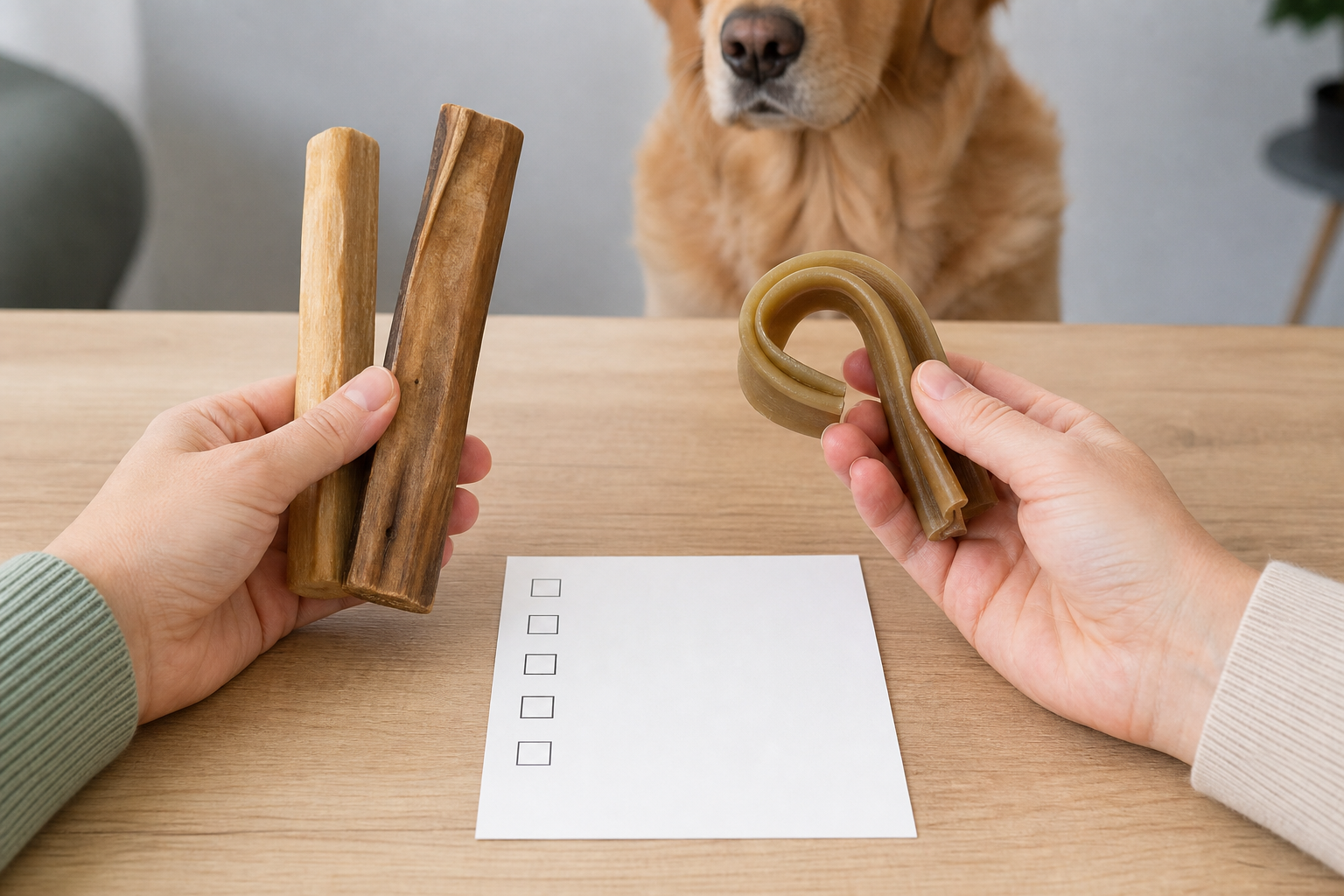
Checkout Checklist For A Wood-Style Dog Chew
- Size: choose a chew that is too large to swallow whole and still safe after wear. If the listing does not show dimensions, do not guess from the photo.
- Hardness: avoid anything that feels harder than your dog’s teeth can reasonably handle. A cheap chew is not cheap after a dental injury.
- Life stage: teething puppies and older dogs may need softer options. Do not buy a hard chew just because the product page says “natural.”
- Chewing style: a gentle gnawer and a power chewer are not shopping for the same item.
- Supervision: plan to watch the first sessions. Remove the chew if pieces break off, sharp edges form, or the chew becomes small enough to swallow.
- Clean storage: store chews away from moisture and dirt. The FDA’s pet treat handling advice is a useful reminder that pet treats can still carry contamination risks.
- Return policy: check whether opened pet chews can be returned. Many bargain bins and limited-time promotions are less forgiving than they look.
When The Deal Is Actually Useful
A wood-style chew can make sense for a dog that likes to gnaw calmly, is past the fragile puppy-teething stage, has no known dental problems and can be supervised. It may also be useful if you are trying to redirect a dog away from furniture, garden sticks or random outdoor debris.
The value improves when the chew is clearly sized, the seller explains replacement timing, and you are not buying a multi-pack before you know your dog will use it safely. A single correctly sized chew is often a better first purchase than a big discounted bundle.
Deal And Coupon Checks Before Paying
Do not let a “while stocks last” offer make the decision for you. For a hard chew, the better deal is the one with a clear size, readable materials information, realistic use instructions and an easy way to stop using it if your dog chews differently than expected.
If you are comparing Aldi, Amazon, Chewy, Petco, PetSmart or a local pet store, look at the unit price only after safety basics pass. Check whether a coupon applies to the exact size, whether a multi-buy discount locks you into too many chews, and whether the product page includes third-party marketplace sellers with different return or quality-control details.
Be careful with broad wording such as “vet recommended,” “safe for all dogs,” “non-splintering” or “dental cleaning” unless the seller explains what that means. AAFCO notes that treats and chews are generally not meant to be complete and balanced nutrition, so do not treat a chew as a diet upgrade or dental-care replacement.
What To Avoid
- A chew small enough for your dog to gulp.
- A hard chew for a puppy with baby teeth unless your veterinarian says it is appropriate.
- Any chew that develops sharp points, cracks or loose chunks.
- Leaving a new chew with an unsupervised dog, especially a power chewer.
- Buying only by price, color or “natural” wording.
- Using a chew to ignore bad breath, mouth pain, bleeding gums or a dog suddenly refusing food. Those are reasons to call your veterinarian.
Quick Answers
Are coffee wood chews safe for every dog?
No. They may suit some calm adult gnawers, but hard chews are a poor fit for some puppies, seniors, dental-risk dogs and power chewers. Match the chew to your dog and ask your veterinarian if you are unsure.
Is a wood chew better than a bone?
Not automatically. The key issue is whether the item is hard, abrasive, swallowable or likely to break into risky pieces. Do not assume “wood” means safer than “bone.”
Should I buy a multi-pack first?
Usually no. Buy one correctly sized chew first, supervise use, then decide whether a larger pack is worth it.
Can a chew replace brushing or dental care?
No. A chew may give a dog something appropriate to gnaw, but it should not be treated as a substitute for veterinary dental advice, tooth brushing or care for mouth pain.
Sources
- Aldi UK Press Centre, “Aldi’s sell-out pet pool is back and pooches are celebrating with an exclusive pool party,” published June 18, 2026.
- Cornell University College of Veterinary Medicine, “FDA bone treat warning: Cornell veterinarian explains how you can protect your dog.”
- VCA Animal Hospitals, “How to choose the best chew toy for your dog.”
- AAFCO, “Treats and Chews.”
- U.S. Food and Drug Administration, “Tips for Safe Handling of Pet Food and Treats.”
Sources last checked June 20, 2026, 13:35 Europe/Rome.