
#crate training
#dog crate
#dog supplies
#pet deals
#puppy supplies
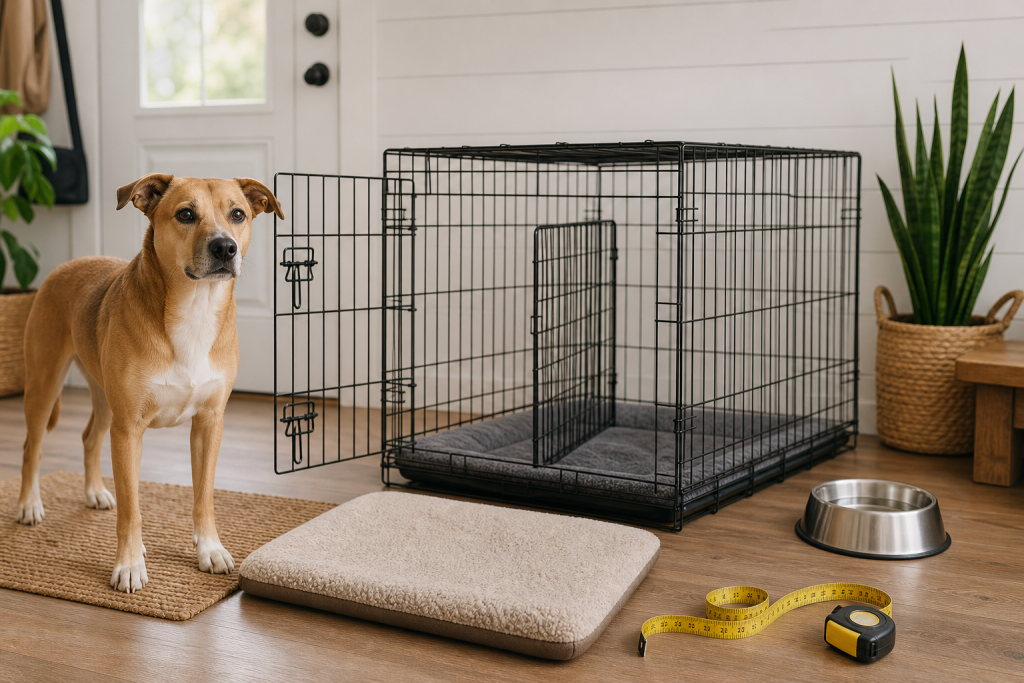
A cheap dog crate stops being a deal when it is the wrong size, missing a divider or too awkward to return after assembly. The right crate should let your dog stand, turn around and lie down comfortably, but it should not be bought by breed label or bargain price alone. Before checkout, measure your dog, check the door layout and divider, and confirm whether the crate is meant for home training, car use or airline-style travel.
Dog crates are showing up in sale sections again as summer travel, puppy adoption and Prime Day-style deal events push owners toward bulky pet gear. That makes the checkout mistake more expensive: an oversized wire crate, a too-small furniture crate or a soft crate bought for a heavy chewer can become a return problem before it becomes a useful safe space.
Why the Size Chart Is Only a Starting Point
Cornell’s Riney Canine Health Center says crates can be useful when a dog learns, through positive reinforcement, that the crate is a safe place to settle. The crate still has to fit the individual dog. A listing that says “medium” or “for Labradors” cannot know your dog’s leg length, neck carriage, tail set or whether the dog is still growing.
AKC crate-training guidance gives a practical puppy-shopping clue: buy for expected adult size when appropriate, then use a divider to make the space smaller while the puppy grows. That is different from buying the biggest discounted crate and hoping the extra room solves everything. Too much space can work against house-training, while too little space is uncomfortable and unfair.

The Checkout Checks That Matter
- Measure length and height. Measure from nose to the base of the tail, then from the top of the head or ears (whichever is higher in a natural stance) to the floor. Compare those numbers with the seller’s internal dimensions, not only the box label.
- Check the divider. If you are buying for a puppy, confirm the divider is included, fits securely and can be moved without special parts you may lose.
- Match the crate type to the dog. Wire crates are airy and easy to inspect. Plastic kennel-style crates feel more enclosed. Soft crates are lighter, but they are not a good bet for dogs that scratch, chew or panic.
- Look at doors and placement. A two-door crate can be easier in tight rooms. Furniture-style crates may look better but can be harder to move, clean or return.
- Read tray, latch and floor details. Removable trays, secure latches, rounded edges and replacement parts matter more than a pretty product photo.
A Deal Is Not a Deal If Return Shipping Is Awkward
Crates are bulky, and bulky returns can be the hidden cost. Chewy’s return policy says eligible items can be returned within 365 days with free return shipping. Petco and PetSmart also publish return policies, but the exact process can depend on where you bought the item, how it was delivered and whether you still have proof of purchase.
Before paying, check whether the crate ships assembled, whether it can be folded back into the box, whether store return is available, and whether sale or marketplace listings have different rules. If a coupon only saves a small amount but leaves you stuck with a 42-inch crate that does not fit your space, it is not the better buy.
Home Crate, Car Crate and Travel Kennel Are Not the Same Purchase
A home training crate is mainly about fit, comfort, cleaning and positive association. A car crate adds vehicle space, tie-down options and crash-safety questions. An airline-style kennel has airline and route rules that ordinary home crates usually do not meet.
If the listing tries to serve every use case at once, slow down. A crate that is fine for naps in the living room may be wrong for an airline, and a heavy-duty escape-resistant kennel may be more crate than a calm, crate-trained dog needs at home. When training, anxiety or confinement stress is part of the decision, ask your veterinarian or a qualified trainer before relying on hardware alone.
What to Avoid
- Buying by weight range only, especially for long-bodied or tall dogs.
- Choosing a furniture crate before checking interior dimensions and ventilation.
- Assuming a soft crate will contain a dog that chews, paws or panics.
- Leaving collars, tags or dangling gear on a crated dog without considering snag risks.
- Using the crate as punishment instead of building a calm, positive routine.
- Skipping return terms because the sale price looks too good to miss.
Quick Answers
Should I buy a bigger crate so my puppy can grow into it?
Often, yes, but only if the crate includes a secure divider or you buy a compatible one. The puppy should not start with the full adult-size space if that makes training harder.
Is a wire crate better than a plastic crate?
Not always. Wire crates give airflow and visibility, while plastic kennel-style crates can feel more den-like and may suit some travel uses. The better choice depends on your dog and where the crate will be used.
Are furniture-style crates worth the higher price?
They can be, but only if the interior fit, ventilation, cleaning access and return policy are as good as the look. Do not pay furniture prices for a crate your dog cannot use comfortably.
What is the biggest crate deal mistake?
Buying from the discount badge before measuring the dog and the room. With crates, a few inches can decide whether the product is useful or becomes a bulky return.
Sources
Sources last checked June 14, 2026, 19:34 Europe/Rome: American Kennel Club, How to Crate Train Your Dog in Nine Easy Steps; Cornell University College of Veterinary Medicine, Dog crates: When to use them and how to pick one; Chewy, How to Choose the Perfect Dog Crate and Returns; Amazon, Best Sellers in Dog Crates, used as a current demand signal only; PetSmart, Promotional Terms and Returns and Refunds; Petco, Returns.