
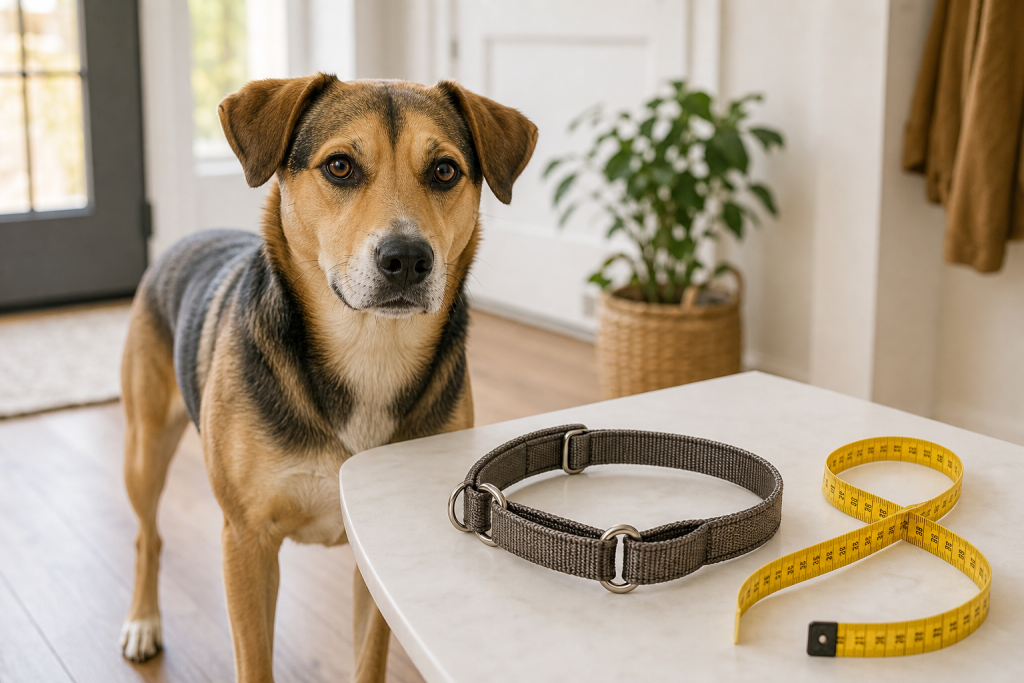
#dog collar
#dog supplies
#dog walking
#martingale collar
A martingale collar deal is only useful if the collar can tighten just enough to prevent backing out without choking or pinching your dog. The mistake is buying it like a regular flat collar, by neck size alone, and skipping the head measurement, adjustment range and release style. For some dogs it can be a practical walking tool, but it is not a cure for pulling and it should not be left on unsupervised.
Martingale collars are showing up in more dog-walking and training searches because owners want more control without jumping straight to aversive gear. They are especially tempting during summer travel, adoption and walking-supply sales, when a discounted collar looks like a simple fix for an escape-prone dog. The checkout risk is that a limited-slip collar has more failure points than a basic buckle collar: the loop, the hardware, the fit range, the fabric width and the return policy all matter.
What a martingale collar actually does
A martingale, also called a limited-slip collar, has a main collar loop and a smaller control loop. When leash pressure is applied, the control loop tightens the main loop by a limited amount. VCA Animal Hospitals explains that this design can reduce escape risk compared with a buckle collar, but it must be fitted correctly so it does not choke, cause discomfort or become tangled.
That is why the cheapest collar in the right color is not automatically a smart buy. A martingale has to match your dog’s head, neck, coat, walking style and supervision habits. If your dog pulls hard, coughs on collars, has a neck or breathing condition, is recovering from an injury, or reacts strongly on leash, ask your vet or a qualified positive-reinforcement trainer before relying on any neck collar.
The fit check to do before you buy
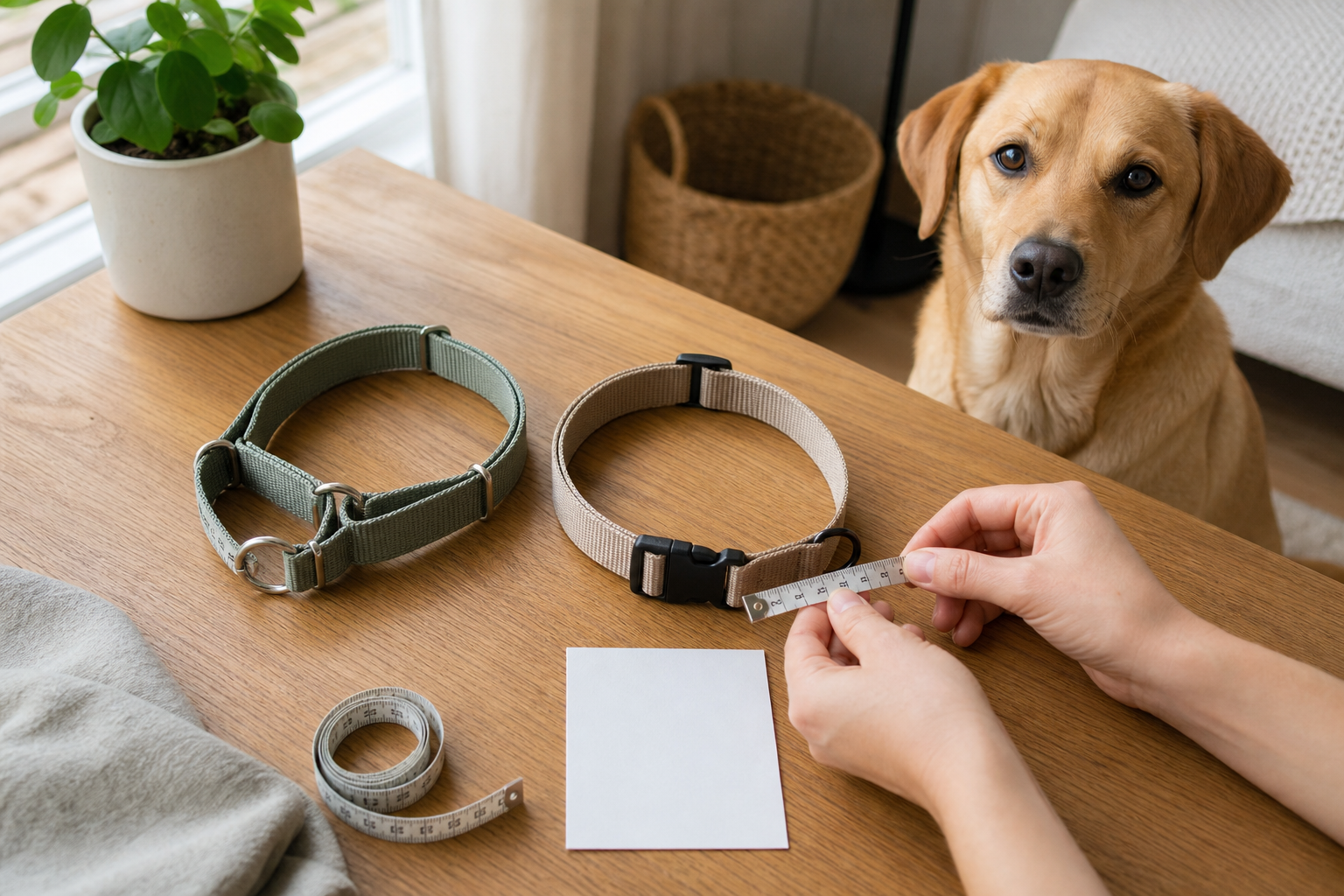
Start by measuring the widest part of your dog’s head and the place on the neck where the collar will sit. A slip-on martingale has to pass over the head, then adjust down securely at the neck. A buckle martingale can be easier to fit on dogs whose head and neck measurements are close, and it can be removed faster if the collar snags.
Check the retailer’s size chart against both measurements, not just breed or weight. Breed labels are weak shortcuts because dogs with the same weight can have very different head and neck shapes. If your dog is between sizes, do not assume the smaller one is safer. The safest choice is the size that leaves enough adjustment room for a proper fit when the control loop is relaxed and when it is fully tightened.
The checkout details that decide whether it is a deal
Before paying, open the product details and look for these practical points:
- Buckle or slip-on: a buckle can make daily removal easier, while slip-on styles need more precise head and neck sizing.
- Hardware shape: rings should move smoothly without sharp edges, twisting or tiny gaps where fabric can jam.
- Control-loop limit: when fully tightened, the collar should still be limited by its design, not keep shrinking like an unlimited slip collar.
- Width: very narrow collars can concentrate pressure, while very wide collars may not suit small dogs or short necks.
- Coat and hair: long hair can catch in hardware or the sliding loop, so inspect the loop path before the first walk.
- Return terms: collars can look right online and still fit poorly, so a returnable item is worth more than a final-sale bargain.
Do not judge the deal only by the first price. A low-cost martingale that has weak stitching, rough hardware or a confusing size chart can become a replacement purchase. If the listing does not show the full adjustment range, the collar width, the hardware material and clear photos of the control loop, keep shopping.
When a martingale is the wrong shortcut
A martingale should not be used as an all-day collar or a tie-out collar. VCA specifically warns that dogs should be supervised when wearing collars and harnesses, and notes that martingales can become entangled or uncomfortable if fitted poorly. Remove it at home, in crates, during rough play and any time your dog is not directly supervised.
It is also not a training shortcut for hard pulling. ASPCApro describes a martingale as an option for dogs that do not pull hard and do not have medical contraindications for collar use. If the leash is tight for most of the walk, the collar is spending too much time under pressure. In that case, a well-fitted harness plus training support may be the better shopping decision.
Deal and coupon checks before paying
If a coupon applies, confirm that it does not push you into the wrong size just because only one color or size is discounted. Check whether the collar is sold by the retailer directly or by a marketplace seller, whether returns are free, and whether used or tried-on pet gear has different return rules. For multi-dog households, do not buy a bulk pack unless each dog has been measured separately.
Personalization can be useful, but it can also make the item final sale. If you add embroidery or a custom tag, verify the spelling, phone number and return policy before ordering. The ASPCA recommends up-to-date identification on a collar or harness when traveling, and AAHA reminds owners to keep microchip registration current too. A martingale can help with leash security, but it is not a replacement for readable ID and a registered microchip.
What to avoid
- Buying by breed name only.
- Leaving a martingale on an unsupervised dog.
- Using it with a retractable leash or as a tie-out collar.
- Choosing a collar with no clear size chart or no photo of the control loop.
- Ignoring coughing, gagging, neck sensitivity, breathing problems or sudden behavior changes.
- Assuming a martingale will train loose-leash walking by itself.
Quick answers
Is a martingale collar better than a flat collar?
It can be better for some dogs that can back out of a flat collar, but only if it is fitted correctly and used under supervision. A flat collar may still be enough for calm dogs that do not slip their collars.
Can a martingale collar choke a dog?
It should not choke when properly fitted, but poor fit or misuse can cause discomfort or risk. That is why the adjustment range and fully tightened fit matter before the first real walk.
Should puppies use martingale collars?
Ask your vet or trainer before using one on a puppy. Puppies grow quickly, chew gear, and may need frequent size checks or a different walking setup.
Do martingale collars replace microchips?
No. Collars and tags can help a finder contact you quickly, but a microchip with current registry information is still an important backup if gear comes off.
Sources
Last checked: 2026-07-11 01:35 Europe/Rome.
- VCA Animal Hospitals, Collar and Harness Options for Dogs.
- ASPCApro, How-to Guide, Tips and Videos for Leash Handling.
- American Kennel Club, Finding and Choosing the Right Dog Collar for Your Dog.
- ASPCA, Traveling With Pets? Follow These Expert Dos and Don’ts to Keep Them Safe.
- AAHA, How to Update Microchip Details.