
#automatic ball launcher
#dog toys
#fetch toys
#pet deals
#pet tech
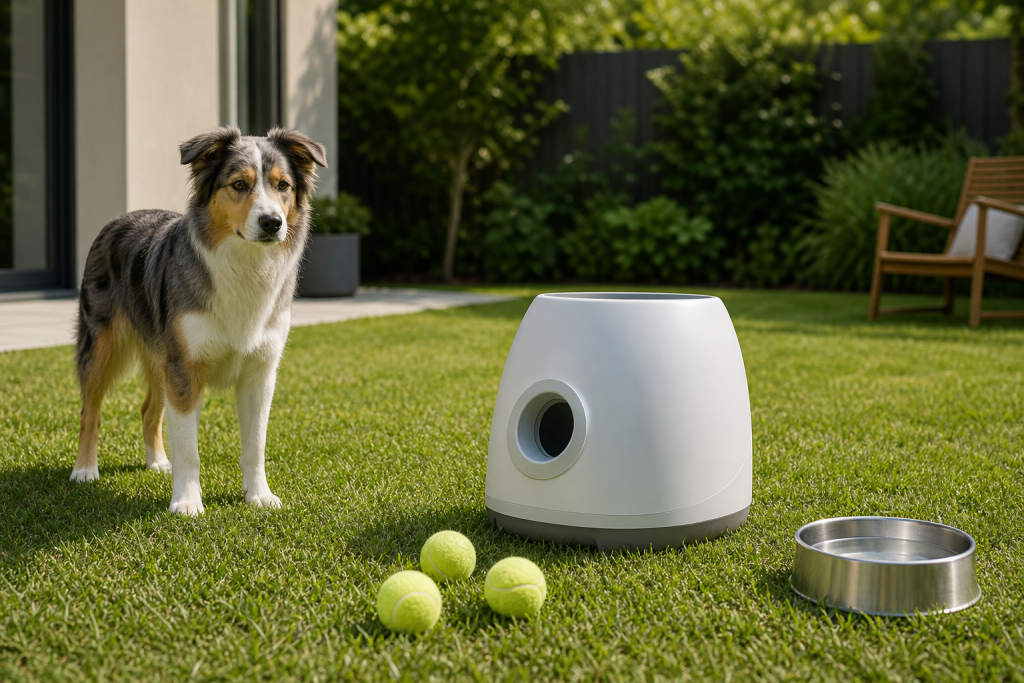
The catch with many automatic ball launcher deals is that the discount does not tell you whether the machine will actually work for your dog, your room, or your checkout total. Before buying, check the ball size, safety sensors, rest mode, power source, return window and whether your dog treats balls as fetch toys or chew toys. A cheaper launcher can become wasted money if it jams, needs batteries you did not price in, or encourages unsupervised play your dog is not ready for.
Automatic launchers sit right in the middle of two current pet-shopping trends: owners are buying more interactive pet tech, and brands are adding automated features to ordinary home products. Interzoo’s 2026 pet-industry trend report highlights smart pet products and interactive toys with cameras as part of the broader move toward tech-assisted pet care. That does not make every launcher a smart buy. It makes the pre-check more important.
Why This Deal Looks Better Than It May Be
The appeal is obvious. A launcher promises more fetch with less effort from you, and it can look like a tidy solution for a high-energy dog. The problem is that fetch is not only about throwing distance. It also depends on your dog’s size, mouth habits, training, stamina, play space and how the machine handles interruptions.
One official product example, the PetSafe Automatic Ball Launcher, lists indoor and outdoor use, multiple distance and angle settings, a power adapter, battery operation, motion sensors and a timed rest feature. Those are useful details, but they are also a shopping checklist. If a competing product page does not explain its sensor range, ball compatibility, play-cycle limits, power options and support policy, the sale price is not enough information.
The Pre-Checkout Checks That Matter
Start with the ball, not the machine. PetSafe’s support guidance says its launcher is designed for standard-size tennis balls measuring 2 5/8 inches, and warns that larger balls may jam while smaller balls may not be detected correctly. If your dog needs a smaller, larger, softer or tougher fetch ball, verify the exact compatible diameter before you buy.
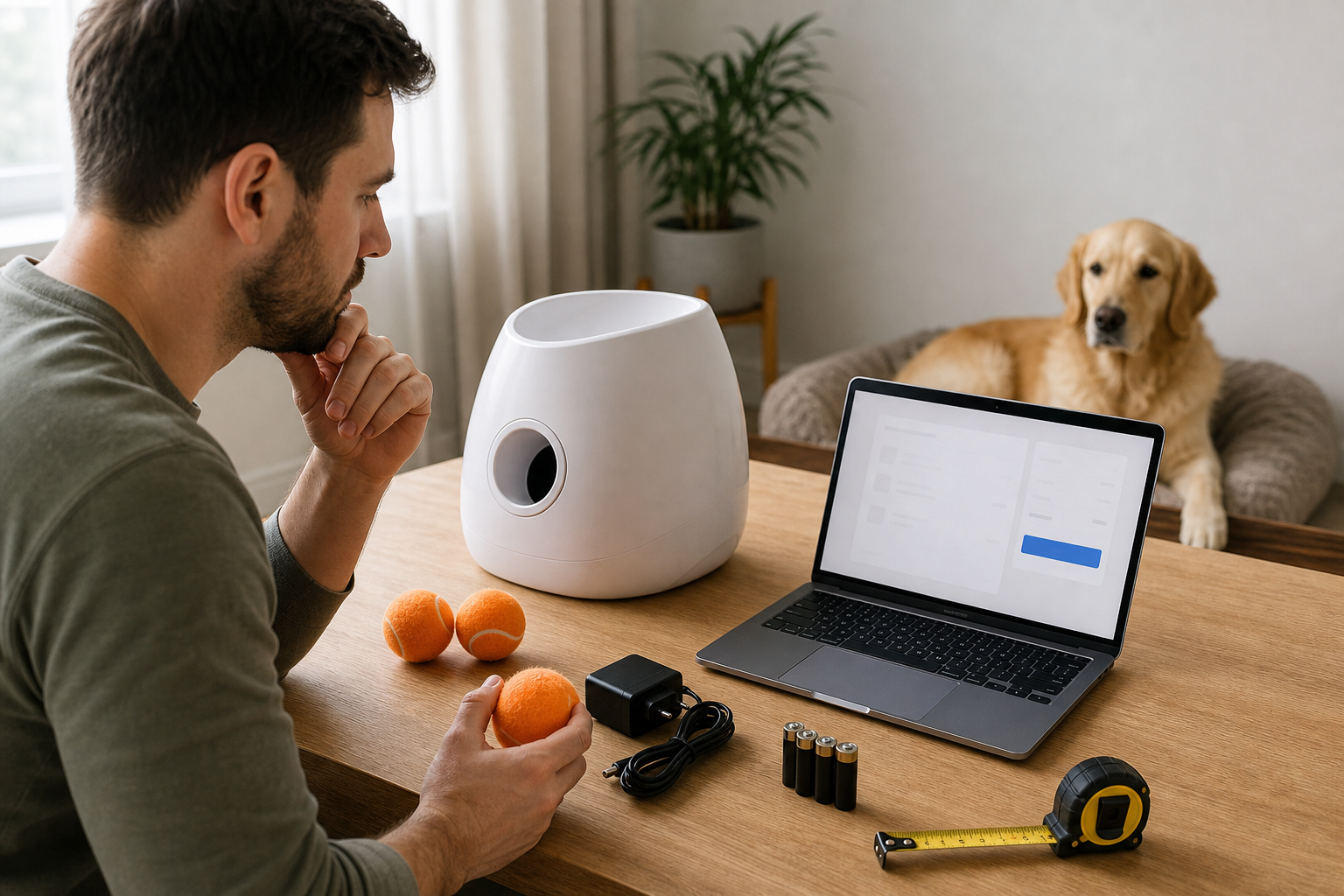
Then check the power setup. A plug-in launcher may be cheaper to run indoors but less useful outside. A battery-powered model may need large batteries that are not included, and that can change the real cost if your dog plays often. If the product uses a rechargeable pack, check replacement availability before assuming it will last for years.
Next, check the safety features in plain language. Look for a motion sensor, an audible launch warning, a rest mode, clear distance settings and instructions that tell the dog to wait away from the launch path. If the listing says only “safe” or “interactive” without explaining how the machine prevents launches toward pets or people, treat that as a reason to slow down.
The Dog Factor Owners Underestimate
Some dogs are perfect candidates for supervised launcher play. Others are not. A dog that guards balls, tries to carry several at once, crushes balls, ignores “drop it” or sprints until exhausted needs more training and closer supervision before any automated fetch device makes sense.
The American Kennel Club warns that tennis balls can create choking and dental-wear risks, especially when dogs chew or shred them. The Center for Pet Safety has also warned owners about ball-toy choking risk and advises that launchers be used to launch away from the dog, not toward the dog. That does not mean every ball launcher is unsafe. It means the “hands-free” promise should never be read as “leave the dog alone with it.”
Deal And Coupon Checks Before You Pay
Do not judge the deal by the headline discount alone. Check whether balls, batteries, adapters, replacement balls, return shipping and warranty support are included. A launcher that uses a less common ball size can quietly add recurring costs if you have to buy brand-specific balls later.
Return terms matter because this is a fit-and-behavior product. PetSafe’s product page currently points shoppers to a 45-day satisfaction return window for that launcher, while Chewy’s general return policy says eligible items can be returned within 365 days with free return shipping. Those terms can change and may vary by seller, marketplace listing or product condition, so verify the exact return policy in your cart before paying.

If you are buying through a marketplace, confirm who the actual seller is. A product sold by a third-party seller may have different return rules, warranty support or replacement-part access than the same brand sold directly. Screenshot or save the warranty and return terms at checkout if the device is expensive.
What To Avoid
Avoid any listing that shows dogs standing directly in front of the launch opening as the normal way to play. Avoid vague “AI” or “smart” wording that does not explain what the feature does. Avoid buying only because a launcher is heavily discounted if you cannot confirm compatible balls, replacement parts, sensor behavior and the manufacturer’s support channel.
Also avoid using a launcher as a substitute for exercise planning. Rest modes are helpful, but they do not know your dog’s medical history, heat tolerance, joint status or impulse control. If your dog has breathing problems, mobility issues, repeated injuries, obsessive fetch behavior or a condition that changes exercise limits, ask your veterinarian before adding intense automated fetch sessions.
Is An Automatic Ball Launcher Worth It?
It can be worth it for a dog that loves fetch, releases the ball reliably, plays under supervision and uses a ball size the machine is built to handle. It is less convincing for power chewers, dogs that swallow or shred balls, very small dogs whose ball size does not match the launcher, or homes without a clear safe launch path.
A stronger deal is usually the model you can return after a real home trial, not the one with the largest crossed-out price. If the checkout page does not make the trial, return, warranty and replacement-ball costs clear, keep shopping.
FAQ
Can I leave my dog alone with an automatic ball launcher?
No. Treat it as a supervised play device. Dogs can chew, swallow, guard or chase balls in risky ways, and automated devices can jam or behave differently when sensors are dirty or blocked.
Do all launchers use normal tennis balls?
No. Some use standard-size balls, while others use smaller or brand-specific balls. Check the exact diameter and whether replacement balls are easy to buy.
Are tennis balls safe for every dog?
Not for every dog. AKC guidance says tennis balls should be used with awareness of choking and dental-wear risks, especially for dogs that chew or shred them.
What is the first thing to test when the launcher arrives?
Test it without your dog in the launch path. Confirm the sensor, launch distance, sound warning, rest mode, ball fit and power source before introducing your dog calmly and gradually.
Sources
Last checked: 2026-05-31 16:33 CEST, Europe/Rome.
- Interzoo, “Trends at Interzoo 2026: Health, sustainability, AI-supported pet care, and premium-quality pet accessories,” May 12, 2026. https://www.interzoo.com/en/press/press-releases/2026/05/trends-interzoo-2026
- PetSafe, Automatic Ball Launcher product page. https://www.petsafe.com/p/automatic-ball-launcher/PTY00-14665/
- PetSafe Support, “My PetSafe Automatic Ball Launcher Doesn’t Launch Balls.” https://support.petsafe.net/articles/my-petsafe-automatic-ball-launcher-doesnt-launch-balls/
- American Kennel Club, “Are Tennis Balls Safe for Dogs?” https://www.akc.org/expert-advice/advice/are-tennis-balls-safe-for-dogs/
- Center for Pet Safety, “Warning: Ball Toys for Dogs Can Cause Choking.” https://centerforpetsafety.org/warning-ball-toys-for-dogs/
- Federal Trade Commission, “How long will your smart device get software updates? It’s hard to know,” Nov. 26, 2024. https://consumer.ftc.gov/consumer-alerts/2024/11/how-long-will-your-smart-device-get-software-updates-its-hard-know
- Chewy, Returns policy. https://www.chewy.com/app/content/return-policy